
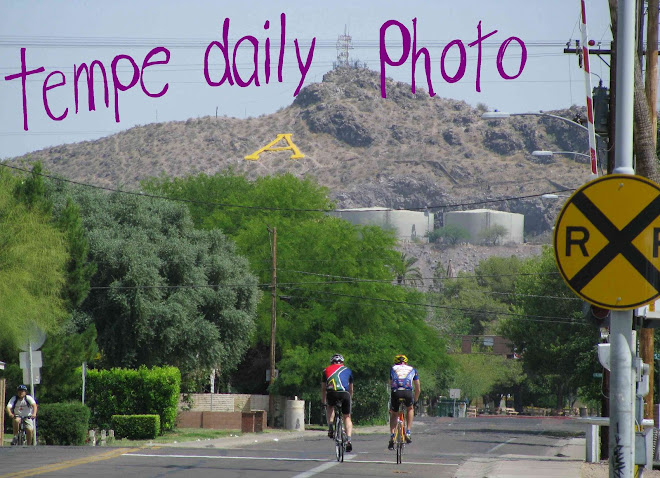
a pair of red-tailed hawks were in flight near "A"
mountain the other day


 a great blue heron sits on a rental boat dock at tempe lake. kayaks and paddle boats are available to rent. lake reflections and ambiance are free. the lakeside area is a great place to run, walk, or ride a bike.
 Yesterday's heavy rains dumped over 2" in under one hour in parts of Tempe. Today, the streets are muddy, littered with debris, and there are puddles all around. The heavy air remains, temperatures are down in the 90s but it's muggy (usually it's a dry heat!) and we are sure to get more rain. Outside the familiar cicada buzz is nonstop (when I first began to write, then abruptly stopped for the evening at 8:19). Earlier I went downtown and was rewarded with a rare sight - several black-necked stilts (Himantopus mexicanus) picking through the lawn puddles near Tempe Center for the Arts by the lake. I'm a big fan of black and white birds, and these are beautiful with their elegant beaks and crazy red stilt legs. They show up when there are puddles around, which is why I don't get to see them in Tempe too often!
 Just a slight head turn west from yesterday's photo, some nice spillage from the dam creates a little wetland. Lakes (even artificial ones) are great things for people, the fish that we stock, waterfowl, and dragonflies, but what most wildlife want are some nice meandering wet areas (no channeling!). It's common to see blue heron, egrets like this one, green heron, and all sort of song birds in these little areas. So important and so full of life!
 I was on my way into the Desert Botanical Gardens for a class tonight and it seemed that every other saguaro lining the roadway had bright red fruits poking out of its crown; each one had its own white winged dove nose deep in big red refreshing plum-sized fruits.

 I shot this photo of an immature verdin, difficult to capture as she flitted around in the coral pink yucca flowers at an eastern ASU entry corridor. Young verdins are plain gray all over. I wouldn't have known she was a verdin by her color, I relied on her size (just a little bigger than a hummingbird) and behavior - she was active and flitting and sounding a call that is familiar to me (I love when these little birds visit my Palo brea tree). Adults have yellow heads and rufous-colored shoulder patches. A very attractive little native bird, found in the southwest U.S. and Mexico.


